AI Is Reshaping the Gateway to Commerce — and Changing How Traffic Works
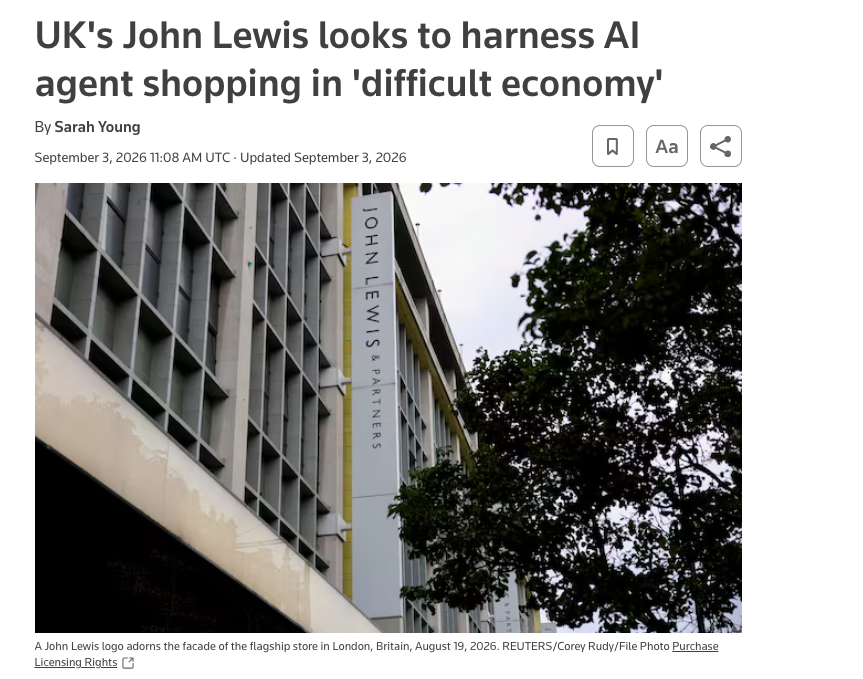
Recently, UK retail giant John Lewis has been exploring an interesting question: what happens when AI agents become part of the product search journey?
The shift is already starting to show up in the data.
According to John Lewis, product searches driven by AI agents have increased from just 0.3% a year ago to 2.5% today.
The number may still seem small, but it points to a much bigger shift: in the future, shopping websites may not be serving only people, but also AI agents making decisions on their behalf.
Most conversations about AI in business still focus on efficiency, automation, and new marketing tools. For consumers, AI is often seen as something that helps compare prices, filter products, or narrow down choices.
But a deeper shift is already underway.
AI is no longer just a tool used by consumers. It is starting to become an active participant in commerce.

And that raises a bigger question:
If business has always been built around human behavior, what changes when AI becomes part of the decision-making process?
The audience is being redefined.
What does that mean?
Humans are no longer the only decision-makers in commerce. AI systems and robots are beginning to enter the market as new decision-making actors.
They read websites, evaluate options, make decisions, and increasingly use machines and tools to perform tasks on factory floors.
Take websites as an example.
In the past, websites were designed mainly for people.
But since around 2020, more than half of internet traffic has come not from humans, but from bots, crawlers, and other automated systems.

AI also “reads” websites — but it does so very differently from people.
Human browsing is gradual.
You land on a website, look around, and if the content seems useful or interesting, you click deeper and keep exploring.
When AI enters a website, it does something very different.
Instead of browsing page by page, it can extract large amounts of content, analyze it, summarize it, and feed that information back into AI systems such as Gemini or ChatGPT.
On the other side, people are increasingly consuming information that has already been filtered and organized by AI.
In the past, people interacted directly with the internet.
In the future, there may be a new layer between people and the internet:
AI.
What happens to advertising when AI becomes part of commerce?

To understand the shift, start with one of the biggest business models on the internet: advertising.
Advertising helped build companies like Facebook, Google, Tiktok. For many of these platforms, advertising and related marketing services have become a major source of revenue.
For Google, one of its most important revenue streams comes from search advertising — and those ads depend heavily on clicks.
But by 2020, the way people used search was already starting to change.
Data from that year showed that more than 68% of Google searches ended without a click to another website.
In other words, users were increasingly getting what they needed directly from the search results page, without visiting a separate site.
In other words, when someone searches for a keyword, many of the links shown in the results are never actually opened.
And without a click, Google misses out on the advertising revenue tied to that click.
The same logic applies to e-commerce platforms like Amazon, where advertising makes up a significant share of revenue.
Now imagine a different shopping journey.
What if, in the future, an AI assistant like chatgpt searches the platform for you, compares products, filters the options, and helps you complete the purchase directly inside the AI interface?
If that happens, how many of the ads on Amazon will users still actually see?
So AI is not simply making existing systems more efficient. It could fundamentally reshape many of the business models we have relied on for years.
If attention is shifting, where are the new opportunities?
Advertising is only one example.
More broadly, people’s attention is starting to move away from the places where it used to be concentrated.

In the past, we spent time searching for products, browsing product pages, and reading customer reviews.
Now, AI is starting to do more of that work for us. People increasingly receive information that has already been searched, filtered, compared, and summarized by AI — and in some cases, AI may even help make the final decision.
Humans are no longer the only participants in commerce.
The market is being reshaped as both humans and machines become active participants in the economy.
And that shift could bring major changes.
Change creates opportunity.
Advertising isn’t going away. But for people working in the industry, the more important question is:
As human attention moves away from traditional platforms, where will it go next?